How to Add a Straight Matcha Program to Your Coffee Shop?
It’s common to see the matcha latte as the first matcha beverage to be introduced into a coffee shop. A straight matcha program takes it one step further: matcha whisked with water, served hot or on the rocks. Grade, water, and barista skill are all reflected in the cup, as there is no milk or syrup to soften it.
In this blog, we will address what matcha for coffee shops requires at this stage: matcha grade, equipment, a consistent recipe, and habits to last during a rush.
What Happens to Matcha If It’s Served Without Milk?
Milk is used to balance the bitterness in a latte. In a straight matcha, the freshness and grade of the powder show at once. This is why most shops use ceremonial grade matcha here. It is made for drinking with water and is generally smoother and sweeter than latte or culinary grades.
There is no regulation of the term “ceremonial,” so two powders that have the same label can taste drastically different. Matchia, a wholesale matcha supplier in Hayward, California, provides a description for each grade based on the type of drinks it is best for, making it easier to compare options than just reading the label.
| Drink | Starting recipe | What the grade must deliver |
| Hot straight matcha | 2 g matcha, 60 ml water | Smooth taste, low bitterness, fine foam |
| Iced straight matcha | 2 g matcha, 30 ml warm water, then cold water and ice | Clear flavor that holds up when chilled |
| Matcha latte | 2 to 3 g matcha, milk of choice | Strong color and flavor through milk |
Which Tools Does a Matcha Bar Station Need?
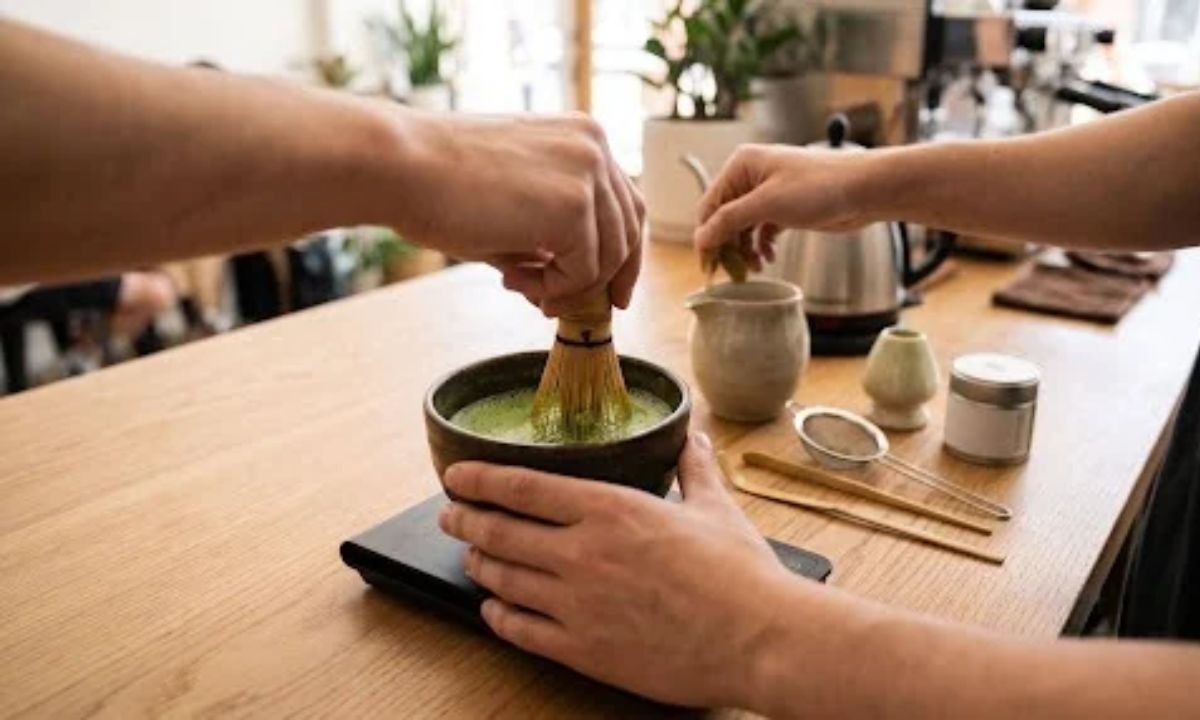
A straight matcha station needs very little space, but each tool has a job.
Have these essentials ready:
- A bamboo whisk (chasen) for each station, plus a spare.
- A fine mesh sifter to break up any clumps.
- A digital scale that can measure to 0.1 g.
- A kettle that can be heated to varying temperatures or a good thermometer.
- Small pitchers or spouted bowls to pour from.
- Portioned powder containers that are opaque and airtight.
How to Prepare One Cup the Same Way Every Time?
A recipe helps to make a good drink into a consistent one.
Start here and tweak it once you’ve tasted it.
Step 1: Sift 2 g of matcha into the bowl.
Step 2: Add 60 ml (about 2 oz) of water at around 175°F (80°C). Many cafés use water between 160°F and 180°F, so taste a few cups to see which you like best.
Step 3: Whisk briskly in a zigzag manner for about 15 seconds, until a fine foam is created on top.
Step 4: Serve immediately, as matcha will settle easily. If it’s an iced beverage, whisk with a bit of warm water and then pour over cold water and ice.
How to Select the Right Ceremonial Grade?
Taste it; do not buy it because of the price or packaging. Repeat the process with 2 or 3 ceremonial grades and the same recipe and water. Judge color, aroma, bitterness, and finish, then taste it iced as well.
Don’t make the first test too large. For instance, Matchia’s ceremonial matcha wholesale comes in 15 g samples per grade and orders of 1 kg per grade or more are accepted. A 15 g sample makes about 7 test cups at 2 g each, which is enough for a fair test.
The price per serving is also important. At 2 g per drink, a 1 kg bag gives about 500 servings, which makes it easy to price each cup.
How to Keep Quality Steady During a Rush?
Most consistency problems come from prep and storage, not the recipe.
These habits help:
- Weigh out each shift’s matcha at the start of the shift and keep it in labeled, opaque containers.
- Avoid having powder stored near the espresso machine, oven or direct light.
- Put a spec card up with grams, water volume, temp and whisk time at the station.
- Rinse the whisk after every drink and dry it completely at closing.
- Make one calibration cup each morning before service and taste it.
Conclusion
A straight matcha program is best implemented with a small initial base: one hot matcha, one iced matcha, a written recipe, and 2-3 ceremonial grades tasted in your shop. If the recipe holds up through a busy morning, order samples of your top grades and then place your first order.
Frequently Asked Questions (FAQs)
How many grams of matcha do you use for one serving of matcha?
A good starting point is 2 g of matcha and 60 ml of water. Set your own spec after tasting.
What water temperature works best for ceremonial matcha?
The temperature most cafés will use is 160°F to 180°F. Boiling water will make the matcha bitter.
Can latte grade matcha be served straight?
It can, but latte grades are built to stand up to milk and can taste more tannic with water alone. Test prior to putting it on the menu.
How should a café store open matcha?
Keep opened matcha in an airtight, opaque container in a dark, dry place away from heat. Keep unopened stock in the fridge, and let a bag come to room temperature before opening it to prevent condensation.